These cards paraphrase public institutional catalog descriptions and identify their limits. They are not line-by-line transcriptions of handwritten manifests or complete translations of ancient inscriptions. Open each holding institution’s record for the object itself. A source can support a narrow claim without proving a much larger identity theory.
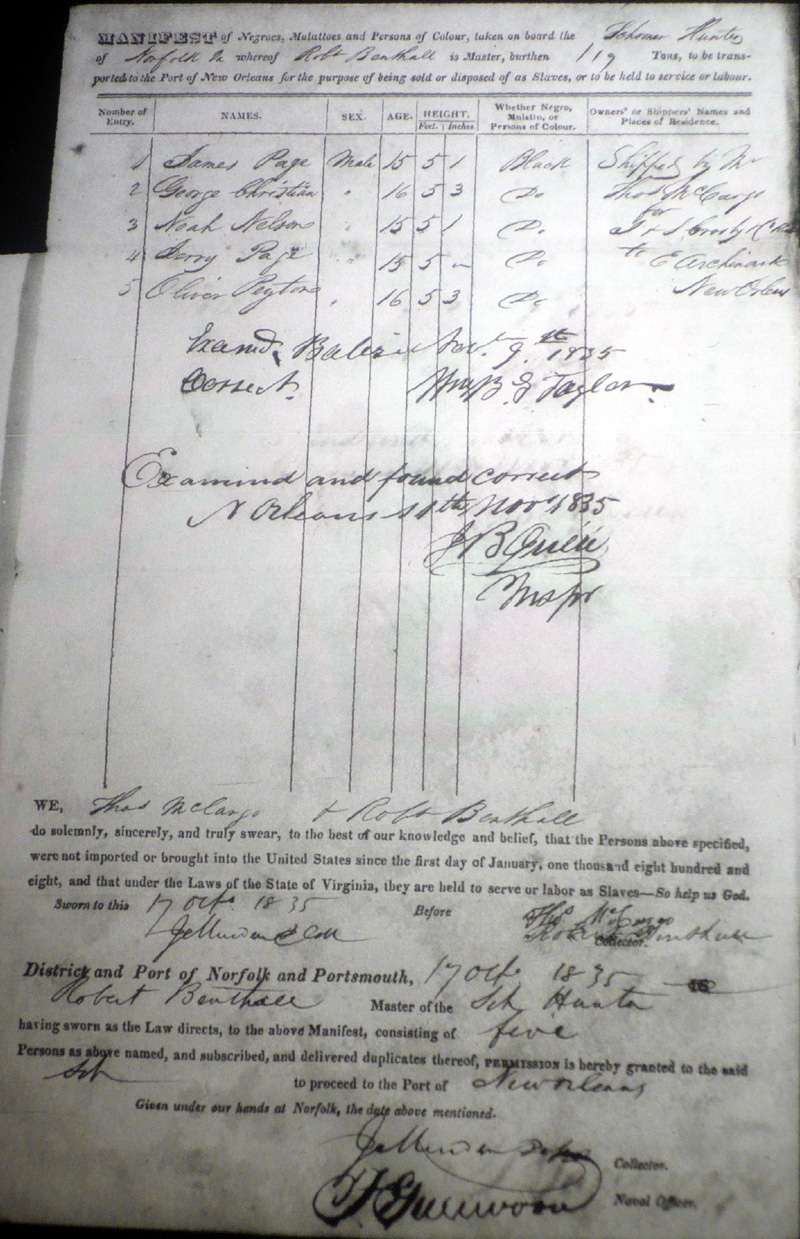
The visible form is a numbered manifest for the schooner Thomas Hunter. Five person entries appear beneath printed columns for names, sex, age, height, recorded racial category, and owner or shipper. The port certification is marked Norfolk and Portsmouth in October 1835. This is a selective transcription of structural fields, checked against the scan; the handwritten personal names have not received a second independent reading and are not reproduced here.
Recorded route
Norfolk, Virginia to New Orleans, Louisiana.
Dates in catalog
Departed 17 October; arrived 11 November 1835.
Document type
U.S. Customs coastwise slave-ship manifest; the archive’s guide describes five named enslaved people.
What this supports: A documented voyage and recorded persons in 1835. The archive’s guide supplies the summary above; a full transcription of handwritten lines has not been independently checked here.
Competing explanation and limit: Similar names across centuries may belong to unrelated people. This manifest does not identify a biblical tribe or establish a chain to a living family. The historical record uses dehumanizing categories; this site describes people as people.
Limit: First names alone make later person-by-person identification especially uncertain. The route is evidence of a forced movement recorded by officials, not of a specific ancient ancestry.
British Museum · 1855,1003.1
Taylor Prism / Sennacherib Prism
Object
Hexagonal clay prism bearing a Neo-Assyrian royal inscription.
Catalog event
The museum identifies a description of tribute from Hezekiah of Judah in a 701 BCE campaign.
What this supports: An Assyrian ruler’s official account names a Judean king in its campaign narrative. Compare its rhetoric and emphases with the biblical narrative.
Competing explanation and limit: Royal inscriptions were political texts designed to present a ruler favorably. Differences between accounts invite comparison; the artifact alone does not prove every reported detail, nor a modern identity claim.
Library of Congress · Dead Sea Scrolls exhibition
Psalms Scroll and the four-letter name
The Library of Congress exhibition describes a Psalms Scroll containing a collection of psalms and hymns, with variations in sequence and detail. Its exhibit notes that the divine name is written in paleo-Hebrew script. This is evidence about manuscript practice in a particular witness.
Limit: The museum caption is a readable institutional description, not this site’s full scroll transcription. A written name cannot establish a precise ancient spoken pronunciation.
Source and correction ledger
Current review: 26 September 2026. The card text is an original paraphrase based on the linked institutional records. Dates and object identifiers are included so a reader can check the source. No handwritten line transcription or complete inscription translation is represented as reviewed.
Editorial changes: v1 adds accession-level cards and explicit competing explanations. Later changes should name the date, changed claim, and source before replacing a card.